A visit between Dawn to Dusk! A visit to all three Ranganatha Swamy Temples on the same day between sunrise and sunset! Aren’t you excited right now to go on Triranga Darshan in one day! It is believed a visit to three Sriranganatha Swamy temples between dawn to dusk called “Triranga Darshan”
Bharathiyam was first conceived on March 14, 2000, as a seed idea — long before India’s cultural heritage found a home online. Though the domain was registered on that very day, its deeper blossoming required 25 years of experience, inner churning, and karmic purification.
Every civilization is born, grows, declines, and often disappears into the pages of history. Yet Bharat, the land sanctified by rishis, rivers, and the rhythm of Sanātana Dharma, stands apart. It is not merely a civilization of the past but a living continuum that has nourished countless generations, adapting to time yet never losing its eternal pulse.
Spiritual Movement Spiritual Movements – The Living Rivers of Awakening From the hymns of the Vedas to the songs of the saints, Bharat’s spiritual history flows through countless movements of love, wisdom, and inner transformation. Each age gave birth to seekers who re-discovered the timeless truth — that divinity lives within every heart.
My personal message is about the journey that shaped me, the lessons life taught me, and the realisations that pushed me back onto my own path. Every word you read here is mine — written from my own experiences, my own struggles, and the truths I discovered along the way.
Struggles and happiness are a part of life. If you don’t struggle, you won’t learn anything. If you don’t enjoy happiness, you won’t feel its essence. Both are just two sides of the same coin. Sometimes life feels like you’re swimming against the waves… but it’s only when you swim against the waves that you realise your own strength.
Dharma, Karma & Inner Evolution - In every age, societies celebrate “good people” — those who are kind, giving, honest, and willing to help without hesitation. Their intentions are noble, their hearts are soft, and their actions often uplift others. Yet, paradoxically, these very individuals frequently face exhaustion, heartbreak, and collapse.
Quiet reflections, visual messages, and life insights — shared without noise or debate.
For those who prefer to observe, reflect, and grow at their own pace.
Updates are occasional and intentional.
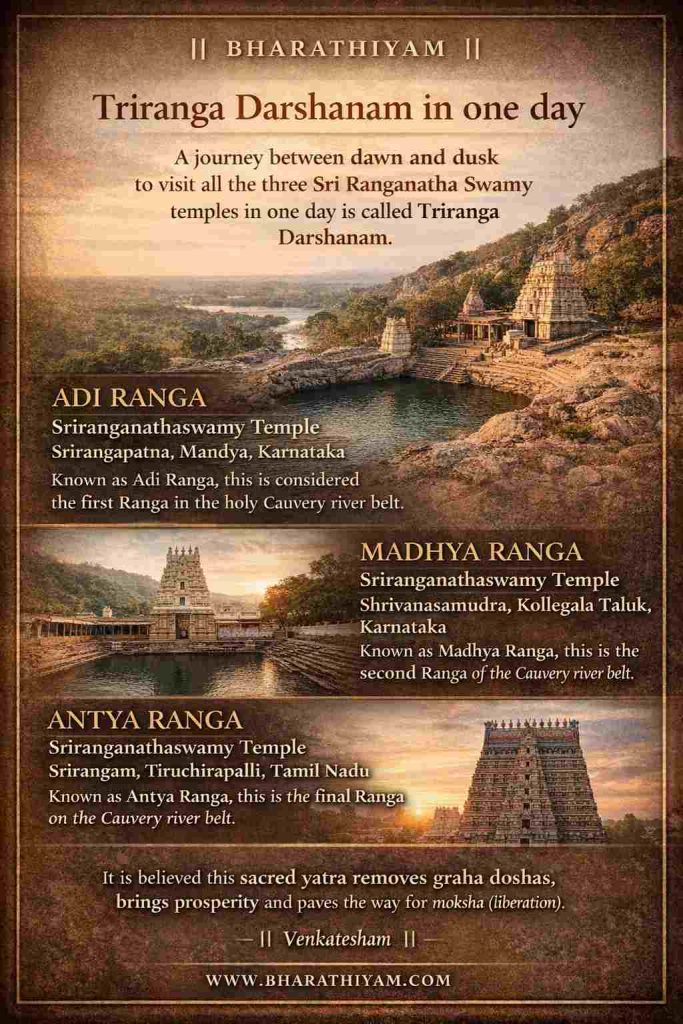
A journey between dawn and dusk to visit all three Sri Ranganatha Swamy temples in one day is called Triranga Darshanam (also known as Triranga Darshan, 3 Ranga Darshan, or Brahmananda Darshana).
According to belief, devotees who complete this sacred darshan receive relief from graha doshas (the malefic effects of planets) and are blessed with peace, prosperity, and spiritual upliftment.
This darshan becomes even more auspicious when performed on Ekadashi and Dwadashi. Scriptures say that Sri Rama himself observed Ekadashi fasting, prayed with devotion, and later defeated Ravana in Lanka with divine blessings. Hence, visiting the temples on these sacred tithis multiplies the benefits of Triranga Darshanam.
The Belief Behind Triranga Darshanam
So, what is Triranga Darshanam? It is the sacred act of visiting and praying at all three Sri Ranganatha Swamy temples on the same day — between sunrise and sunset. The journey begins at Adi Ranga (Srirangapatna), continues to Madhya Ranga (Shivanasamudra), and concludes at Antya Ranga (Srirangam, Tamil Nadu).
Devotees believe that completing this yatra in one day removes graha doshas (malefic planetary effects) and brings blessings for health, prosperity, and spiritual upliftment.
All three temples lie along the holy Cauvery river belt of South India, making this darshan even more powerful. Together, they form one of the most sacred Vaishnavite pilgrimages in the region.
Preparation Before Starting Triranga Darshanam
Undertaking Triranga Darshanam requires careful planning, as all three temples must be visited between sunrise and sunset. Among the most auspicious times to perform this darshan is during Dhanurmasa (December–January), when visiting Sri Ranganatha Swamy is considered especially sacred.
Here are some key preparations before you begin:
Spiritual Preparation – Many devotees observe fasting or simple meals during the journey to maintain focus on devotion.
Start Early – Plan to reach Adi Ranga (Srirangapatna) by around 5:00 AM to begin the journey with enough daylight.
Plan the Route – The darshan requires covering long distances, so map your route in advance.
Carry Essentials – Pack snacks, breakfast, and water, as there will be little time to stop between the temples.
Travel Readiness – Ensure your vehicle is in good condition, as the trip involves continuous travel through multiple districts.
Start Your Engine – The Journey Begins!
If you are ready to take the road for Triranga Darshanam, planning is the key. This sacred yatra must be completed between sunrise and sunset in a single day, covering all three holy temples:
Adi Ranga – Sri Ranganathaswamy Temple, Srirangapatna (Karnataka)
Madhya Ranga – Sri Ranganathaswamy Temple, Shivanasamudra (Karnataka)
Antya Ranga – Sri Ranganathaswamy Temple, Srirangam (Tamil Nadu)
The journey is long, but deeply rewarding. With devotion in the heart and preparation in place, you can set out on this once-in-a-lifetime pilgrimage — a road trip filled with faith, discipline, and divine blessings.
Temple 1: Adi Ranga – Sri Ranganathaswamy Temple, Srirangapatna
Your Triranga Darshanam begins at Adi Ranga, the first and oldest temple of Lord Ranganatha, located in Srirangapatna (Mandya district, Karnataka).
If you are traveling from Bangalore, plan to start very early in the morning to reach the temple by sunrise. The darshan timings are limited, so arriving early ensures you begin the pilgrimage on time.
About Adi Ranga
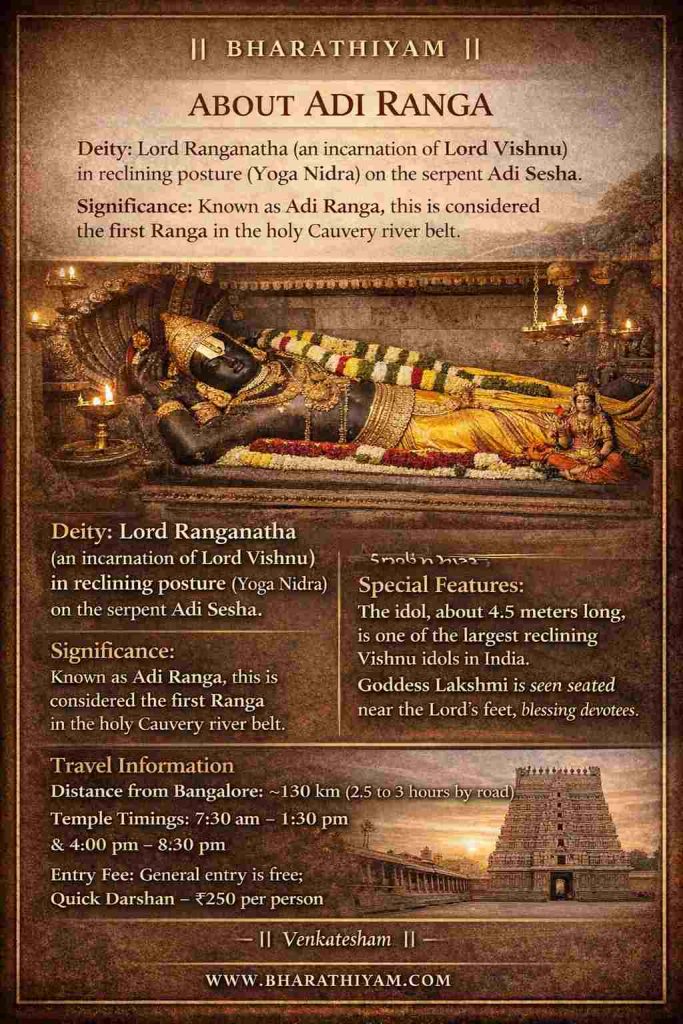
Deity: Lord Ranganatha (an incarnation of Lord Vishnu) in reclining posture (YogaTransliteration: Yoga / योग Meaning / Explanation: Union, alignment, integration of body, mind, and consciousness. Origin: Sanskrit (from yuj — “to unite”) Note: Yoga is a state, not merely a practice. More Nidra) on the serpent Adi Sesha.
Significance: Known as Adi Ranga, this is considered the first Ranga in the holy Cauvery river belt.
Special Features: The idol, about 4.5 meters long, is one of the largest reclining Vishnu idols in India. Goddess Lakshmi is seen seated near the Lord’s feet, blessing devotees.
Heritage: Built in 817 AD by a lady named Hambi, with later expansions by temple dancers in 874 AD.
Travel Information
Distance from Bangalore: ~130 km (2.5 to 3 hours by road). Temple Timings: 7:30 am – 1:30 pm & 4:00 pm – 8:30 pm. Entry Fee: General entry is free; Quick Darshan – ₹250 per person. Address: Srirangapatna, Mandya District, Karnataka – 571438.
Temple 2: Madhya Ranga – Sri Ranganathaswamy Temple, Shivanasamudra
From Srirangapatna (Adi Ranga), your journey continues about 75 km via Bannur and Mavalli to reach the second holy shrine of Triranga Darshanam — Madhya Ranga at Shivanasamudra.
This temple stands beautifully on an island formed by the Cauvery river, built in traditional Dravidian architectural style. The presiding deity here is Lord Ranganatha in his youthful form, affectionately known as Mohana Ranga and Jaganmohana Ranga.
About Madhya Ranga
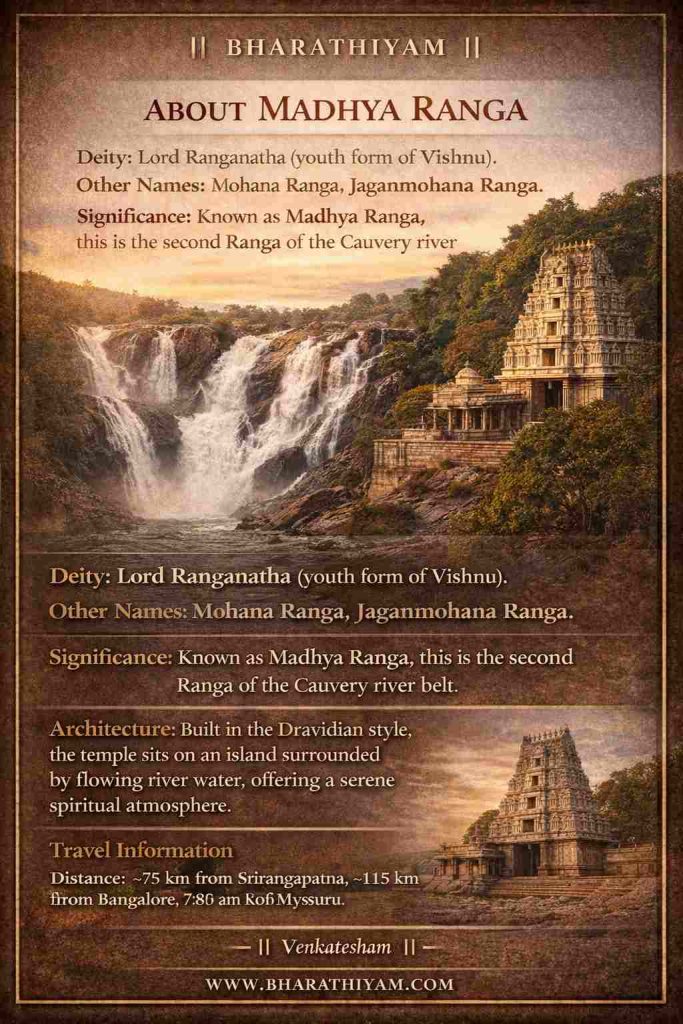
Deity: Lord Ranganatha (youth form of Vishnu).
Other Names: Mohana Ranga, Jaganmohana Ranga.
Significance: Known as Madhya Ranga, this is the second Ranga of the Cauvery river belt.
Architecture: Built in the Dravidian style, the temple sits on an island surrounded by flowing river water, offering a serene spiritual atmosphere.
Travel Information
Distance: ~75 km from Srirangapatna, ~115 km from Bangalore, ~85 km from Mysuru. District: Kollegala Taluk, Chamarajanagara District. Temple Timings: 7:30 am – 8:00 pm (opens at 4:30 am during Dhanurmasa). Entry Fee: Free for general darshan. Address: Shivanasamudra, Sathegala Post, Kollegala Taluk, Chamarajanagara District, Karnataka. Telephone: 08224-253615 Travel Time: ~1.5 to 2 hours by road from Srirangapatna. Coordinates: 12.2704266°N, 77.1696703°E. Email: eo.shivanasamudra@gmail.com
Temple 3: Antya Ranga – Sri Ranganathaswamy Temple, Srirangam
Your final step in the sacred Triranga Darshanam journey is at Antya Ranga, the grandest and largest of the three Ranganatha Swamy temples, located in Srirangam, Tiruchirapalli (Tamil Nadu).
From Madhya Ranga (Shivanasamudra), the journey covers about 290 km via Kollegal – Erode – Namakkal, taking nearly 6 to 7.5 hours by road. Devotees must plan carefully to reach here before sunset, as completing darshan at all three Rangas within the same day brings the true blessings of Triranga Darshanam.
About Antya Ranga
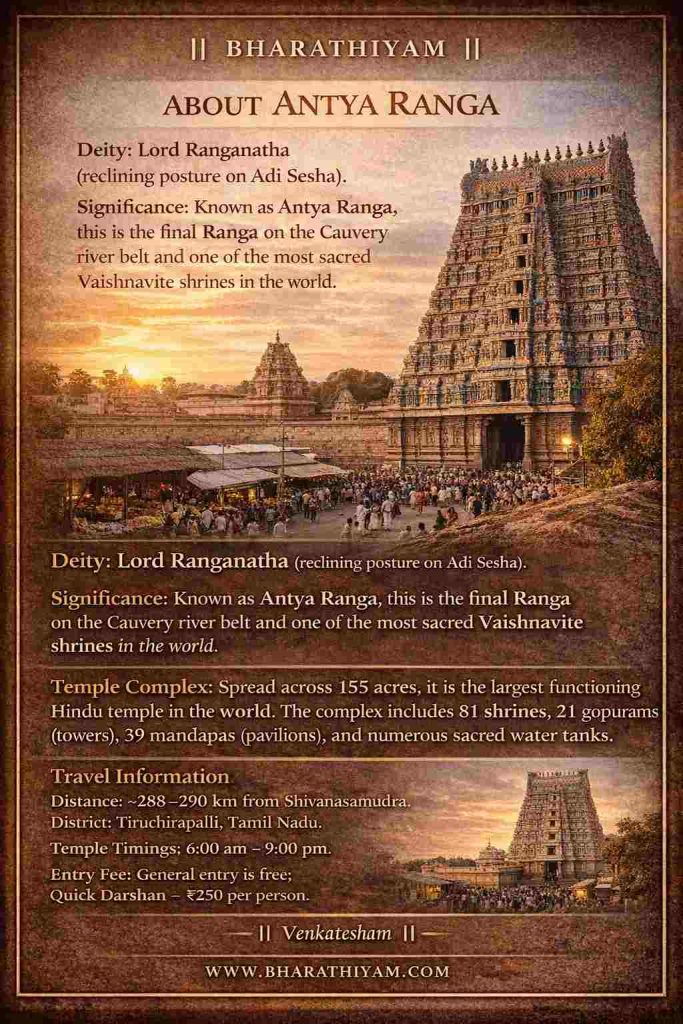
Deity: Lord Ranganatha (reclining posture on Adi Sesha).
Significance: Known as Antya Ranga, this is the final Ranga on the Cauvery river belt and one of the most sacred Vaishnavite shrines in the world.
Temple Complex: Spread across 155 acres, it is the largest functioning Hindu temple in the world. The complex includes 81 shrines, 21 gopurams (towers), 39 mandapas (pavilions), and numerous sacred water tanks.
Heritage: With a history of over 1,000 years, Srirangam temple reflects the richness of medieval South Indian civilization, architecture, and devotion.
Travel Information
Distance: ~288–290 km from Shivanasamudra.
District: Tiruchirapalli, Tamil Nadu.
Temple Timings: 6:00 am – 9:00 pm.
Entry Fee: General entry is free; Quick Darshan – ₹250 per person.
Address: Sri Ranganathar Swamy Temple, Srirangam, Tiruchirappalli, Tamil Nadu.
Telephone: +91 431 2432246
Travel Time: ~6 to 7.5 hours by road from Shivanasamudra.
Temple Deity: Sriranganathaswamy Temple. Sri Anthya Ranga of Triranga Darshanam Location: Srirangam (288 km from Shivanasamudra via Kollegal – Anthiyur Rd and Tiruchengode – Namakkal – Trichy Rd). District: Tiruchirapalli, Tamil Nadu Built-in: More than 1000 years old. Geographical Co-ordination: 10°51′45″N 78° 41′23″E. Temple Timings: 6:00 am to 9:00 pm. Temple Entry Fee: General Entry is Free, Quick Darshan – Rs. 250/- per person, Address: Sri Ranganathar Swamy Temple, Srirangam, Tiruchirappalli Telephone No.: +91 431 -2432246 Travel time: Anywhere between 6 hours to 7 hours 30 minutes. Temple Email ID: srirangam@tnhrce.org
Completing the Sacred Triranga Darshanam
As the sun sets over the holy Cauvery river, completing darshan at Adi Ranga (Srirangapatna), Madhya Ranga (Shivanasamudra), and Antya Ranga (Srirangam) in a single day is considered one of the most blessed pilgrimages in Sanātana DharmaTransliteration: सनातन धर्म / Sanātana Dharma Meaning / Explanation: Sanātana Dharma means the eternal way of righteous living. It is the timeless cosmic law that governs the universe, life, and consciousness. It is not a religion founded by a person, bound to a single book, or limited by geography or More.
Devotees believe that this sacred yatra removes graha doshas, brings prosperity, and paves the way for moksha (liberation). More than just a journey across temples, it is a journey of faith, discipline, and surrender to Lord Ranganatha.
May Lord Ranganatha bless all those who undertake this divine darshan with peace, strength, and spiritual upliftment.
FAQs on Triranga Darshanam
1. What is Triranga Darshanam? It is the pilgrimage of visiting all three Sri Ranganatha Swamy temples (Adi Ranga, Madhya Ranga, Antya Ranga) along the Cauvery river in one day between sunrise and sunset.
2. Why is Triranga Darshanam considered powerful? It is believed to remove the malefic effects of planets (graha doshas), bring prosperity, and grant spiritual upliftment.
3. Which temples are included in the 3 Ranga Darshan?
Adi Ranga: Srirangapatna (Karnataka)
Madhya Ranga: Shivanasamudra (Karnataka)
Antya Ranga: Srirangam (Tamil Nadu)
4. When is the best time to perform this darshan? Any time is auspicious, but Ekadashi/Dwadashi and the month of Dhanurmasa (Dec–Jan) are considered most sacred.
5. Can the darshan be done in one day? Yes. With proper planning and an early start, pilgrims can visit all three temples between dawn and dusk.
“When you are born with a question in your soul, the answer becomes your life’s work.”
Venkatesham is the founder and guiding spirit behind Bharathiyam — a digital dharmic initiative dedicated to reviving, preserving, and sharing the timeless soul-wisdom of Bharat.
Born into a traditional family rooted in simplicity, reverence, and moral strength, his life bridges two worlds — the outer world of technology and digital communication, and the inner world of silence, reflection, and spiritual seeking.
The articles and essays featured on Bharathiyam are not recent creations, but part of a lifelong body of work that began more than two decades ago. Many of them were originally written between 2000 and 2020, stored quietly as Word documents — reflections, insights, and learnings collected through years of sādhanā, study, and service. These writings are now being published in their original spirit, dated according to when they were first composed.
Alongside Bharathiyam, he continues to nurture two interconnected literary trilogies exploring dharma, family, and the soul’s journey — expressions of the same inner quest that began long ago and continues to unfold through his work and life.