My personal message is about the journey that shaped me, the lessons life taught me, and the realisations that pushed me back onto my own path. Every word you read here is mine — written from my own experiences, my own struggles, and the truths I discovered along the way.
Struggles and happiness are a part of life. If you don’t struggle, you won’t learn anything. If you don’t enjoy happiness, you won’t feel its essence. Both are just two sides of the same coin. Sometimes life feels like you’re swimming against the waves… but it’s only when you swim against the waves that you realise your own strength.
Dharma, Karma & Inner Evolution - In every age, societies celebrate “good people” — those who are kind, giving, honest, and willing to help without hesitation. Their intentions are noble, their hearts are soft, and their actions often uplift others. Yet, paradoxically, these very individuals frequently face exhaustion, heartbreak, and collapse.
Quiet reflections, visual messages, and life insights — shared without noise or debate.
For those who prefer to observe, reflect, and grow at their own pace.
Updates are occasional and intentional.
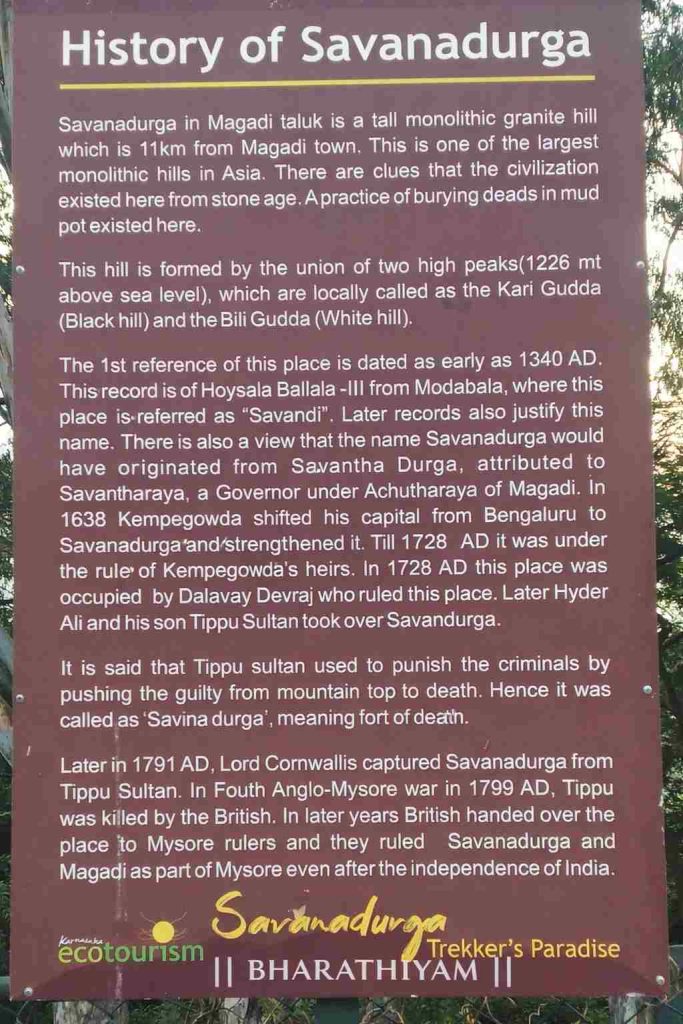
Rising majestically 1,226 meters above sea level, Savanadurga in Magadi taluk, Karnataka, is one of the largest monolithic granite hills in Asia. About 11 kilometers from the historic town of Magadi and roughly 60 kilometers from Bengaluru, it stands as a timeless sentinel of the Deccan landscape — a mountain shaped by myth, valor, and devotion. Composed of two towering outcrops, the Kari Gudda (Black Hill) and Bili Gudda (White Hill), Savanadurga is not just a geological wonder but also a living monument of South India’s layered history.
Archaeological traces reveal that life thrived here since the Stone Age — shards of pottery and burial remains indicate a long-forgotten civilization that honored its dead with rituals in mud pots. From prehistoric settlers to medieval warriors and modern trekkers, the hill has silently watched the tides of time pass by.
Origins Lost in Legend
The earliest mention of this site appears in inscriptions dated around 1340 CE, during the rule of Hoysala Ballala III of Modabala. The place was then referred to as Savandi, possibly derived from “Savandurga” or “Savantharaya Durga,” attributed to Savantharaya, a local governor under Achutaraya of Magadi. Later, in the 17th century, Kempegowda II — the chieftain of Bengaluru — shifted his capital to Magadi and fortified Savanadurga. Its commanding view made it an impregnable watchtower over the region.
The stronghold remained under Kempegowda’s descendants until 1728 CE, when Dalavay Devraj occupied it. Later, Hyder Ali and his son Tipu Sultan took over the fort, making it a bastion of the Mysore kingdom’s resistance against the British.
The Fort of Death and Defiance
Savanadurga’s steep slopes and sheer cliffs earned it a fearsome reputation. Local lore says Tipu Sultan used to punish traitors by hurling them from the precipice — hence the name Savina Durga, meaning Fort of Death. The British chroniclers later described it as one of the most unassailable hill-forts in southern India.
However, even this granite giant fell in 1791 CE when Lord Cornwallis captured it during the Third Anglo-Mysore War. Tipu’s resistance continued, but he was eventually killed in 1799 CE at Srirangapatna. After Tipu’s fall, the British handed Savanadurga and Magadi to the Mysore Wodeyars, where it remained under princely rule until India’s independence.
The Temple Beneath the Rock
At the base of this colossal monolith rests the Sri Lakshmi Narasimha Swamy Temple, a sacred anchor that has preserved the hill’s spiritual energy for centuries. Dedicated to Lord Narasimha, the fierce and protective incarnation of Vishnu, the temple attracts pilgrims year-round. The deity here is locally revered as Savandurga Narasimhaswamy, believed to guard both the hill and the surrounding forests.
According to tradition, sages once meditated in the caves near the temple, and it is said that their austerities sanctified the entire area. The temple complex features Dravidian-style architecture with modest yet ancient shrines, including small sanctums dedicated to Veerabhadra, Hanuman, and Goddess Lakshmi. During the annual Narasimha Jayanthi, thousands of devotees climb the hill barefoot, lighting lamps along the rocky path that glows like a river of flame in the night — symbolizing the soul’s ascent toward the divine.
Nature’s Citadel
Savanadurga is more than a relic of stone and story — it is also a living ecosystem. Surrounding the hill is the Savandurga State Forest, part of the Arkavathi river basin. The forest is home to endangered species such as the slender loris, leopard, barking deer, and several varieties of endemic birds. The ancient Arkavathi River originates nearby, nourishing the land and sustaining Magadi’s agrarian communities.
For trekkers, Savanadurga is a paradise — its rugged trails test endurance while rewarding climbers with panoramic views of the lush forest and distant cityscape. The ascent usually takes about two hours, leading past fort walls, remnants of ancient watchtowers, and occasional shrines where climbers pause to offer prayers before continuing upward.
Echoes of Faith and Freedom
Every part of Savanadurga breathes history. The stone pathways once trodden by Hoysala soldiers and Mysore warriors now carry barefoot pilgrims and adventure seekers alike. Yet, beneath its rugged beauty lies a deeper resonance — a reminder that power and faith, like the twin peaks Kari Gudda and Bili Gudda, are forever intertwined.
Locals still recount tales of Tipu’s hidden treasures, saints who attained siddhi in its caves, and warriors who vanished into misty dawns. To walk on this hill is to walk through centuries — each step echoing with devotion, defiance, and destiny.
Savanadurga Today
Today, Savanadurga is managed by Karnataka Ecotourism, balancing preservation with responsible adventure. The site’s interpretive boards recount its long saga — from prehistoric burials to British conquest — while nearby stalls sell tender coconut water and prasadam from the Narasimha temple. As the sun rises over the granite dome, the entire hill glows golden, and one feels the presence of both geological eternity and divine stillness.
For those seeking both history and transcendence, Savanadurga stands as a perfect symbol — a meeting of the material and the spiritual, of endurance and enlightenment. It reminds us that civilization, however fleeting, leaves its footprints on stone; but faith, once rooted in the heart, carves eternity into the mountain itself.
“When you are born with a question in your soul, the answer becomes your life’s work.”
Venkatesham is the founder and guiding spirit behind Bharathiyam — a digital dharmic initiative dedicated to reviving, preserving, and sharing the timeless soul-wisdom of Bharat.
Born into a traditional family rooted in simplicity, reverence, and moral strength, his life bridges two worlds — the outer world of technology and digital communication, and the inner world of silence, reflection, and spiritual seeking.
The articles and essays featured on Bharathiyam are not recent creations, but part of a lifelong body of work that began more than two decades ago. Many of them were originally written between 2000 and 2020, stored quietly as Word documents — reflections, insights, and learnings collected through years of sādhanā, study, and service. These writings are now being published in their original spirit, dated according to when they were first composed.
Alongside Bharathiyam, he continues to nurture two interconnected literary trilogies exploring dharma, family, and the soul’s journey — expressions of the same inner quest that began long ago and continues to unfold through his work and life.