A visit between Dawn to Dusk! A visit to all three Ranganatha Swamy Temples on the same day between sunrise and sunset! Aren’t you excited right now to go on Triranga Darshan in one day! It is believed a visit to three Sriranganatha Swamy temples between dawn to dusk called “Triranga Darshan”
Bharathiyam was first conceived on March 14, 2000, as a seed idea — long before India’s cultural heritage found a home online. Though the domain was registered on that very day, its deeper blossoming required 25 years of experience, inner churning, and karmic purification.
Every civilization is born, grows, declines, and often disappears into the pages of history. Yet Bharat, the land sanctified by rishis, rivers, and the rhythm of Sanātana Dharma, stands apart. It is not merely a civilization of the past but a living continuum that has nourished countless generations, adapting to time yet never losing its eternal pulse.
Spiritual Movement Spiritual Movements – The Living Rivers of Awakening From the hymns of the Vedas to the songs of the saints, Bharat’s spiritual history flows through countless movements of love, wisdom, and inner transformation. Each age gave birth to seekers who re-discovered the timeless truth — that divinity lives within every heart.
My personal message is about the journey that shaped me, the lessons life taught me, and the realisations that pushed me back onto my own path. Every word you read here is mine — written from my own experiences, my own struggles, and the truths I discovered along the way.
Struggles and happiness are a part of life. If you don’t struggle, you won’t learn anything. If you don’t enjoy happiness, you won’t feel its essence. Both are just two sides of the same coin. Sometimes life feels like you’re swimming against the waves… but it’s only when you swim against the waves that you realise your own strength.
Dharma, Karma & Inner Evolution - In every age, societies celebrate “good people” — those who are kind, giving, honest, and willing to help without hesitation. Their intentions are noble, their hearts are soft, and their actions often uplift others. Yet, paradoxically, these very individuals frequently face exhaustion, heartbreak, and collapse.
Quiet reflections, visual messages, and life insights — shared without noise or debate.
For those who prefer to observe, reflect, and grow at their own pace.
Updates are occasional and intentional.
When we think of the Ramayana, most minds are drawn toward the mighty bow of Rama, the loyalty of Lakshmana, or the devotion of Hanuman. Yet, at the very heart of this grand epic lies another force—gentle, unspoken, but unshakable. That force is Sita’s strength. Her power was not one of weapons or armies, but of steadfastness, endurance, and the ability to uphold dharmaTransliteration: धर्म / Dharma Meaning / Explanation: That which upholds, sustains, and maintains cosmic and social order. Includes duty, righteousness, natural law, and inner truth. Origin: Sanskrit (from root dhṛ — “to hold, support”) Note: Dharma is contextual — it changes with role, time, and stage of life. More in silence. If Rama is the visible flame of righteousness, Sita is the steady oil that keeps it burning.
The Strength of Choice
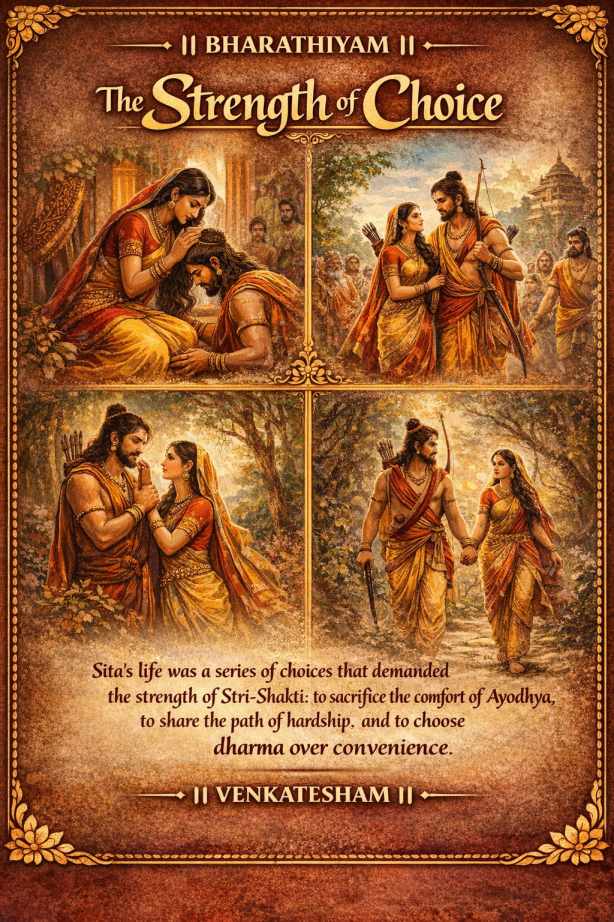
Sita’s life was filled with crossroads that demanded immense inner courage. When Rama was exiled, she could have chosen the comfort of Ayodhya. Instead, she declared that her place was with her husband, in the forest. Her words carried not resignation but determination: to share joy and suffering alike. In this single act, she revealed the essence of strī-shakti—choosing sacrifice over ease, love over security, and dharmaTransliteration: धर्म / Dharma Meaning / Explanation: That which upholds, sustains, and maintains cosmic and social order. Includes duty, righteousness, natural law, and inner truth. Origin: Sanskrit (from root dhṛ — “to hold, support”) Note: Dharma is contextual — it changes with role, time, and stage of life. More over personal comfort.
Her journey into exile was not a passive following, but an active statement of partnership. She reminded Rama that marriage is not about convenience, but about walking side by side, even when the path is filled with thorns.
Strength in Captivity
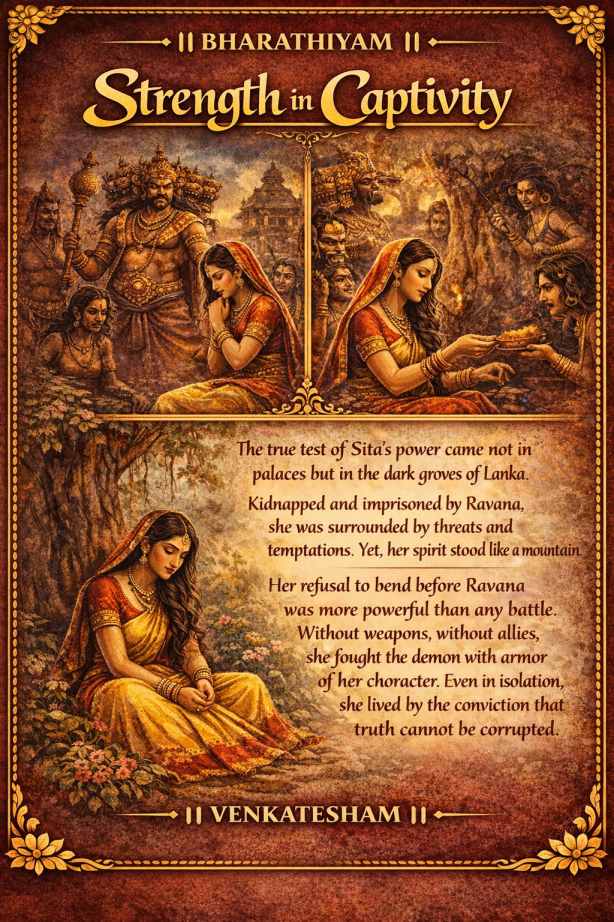
The true test of Sita’s power came not in palaces but in the dark groves of Lanka. Kidnapped and imprisoned by Ravana, she was surrounded by threats and temptations. Yet, her spirit stood like a mountain. She refused to sit on the golden throne offered to her, choosing instead to stay under a tree in Ashoka Vatika.
Her refusal to bend before Ravana was more powerful than any battle. Without weapons, without allies, she fought the demon with the armor of her character. Even in isolation, she lived by the conviction that truth cannot be corrupted. Her silence in Lanka was not weakness—it was resistance.
The Silent Dialogue with Fire
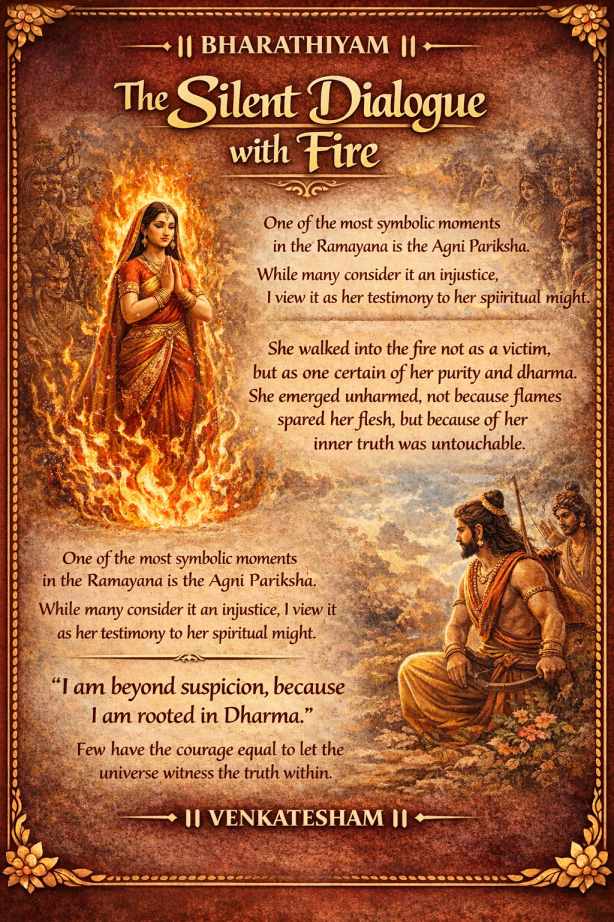
One of the most symbolic moments in the Ramayana is the Agni Pariksha. Here, too, Sita displayed silent strength. While many see this episode as an injustice, it is also a testimony to her spiritual might. She walked into the fire not as a victim, but as one certain of her purity and her dharmaTransliteration: धर्म / Dharma Meaning / Explanation: That which upholds, sustains, and maintains cosmic and social order. Includes duty, righteousness, natural law, and inner truth. Origin: Sanskrit (from root dhṛ — “to hold, support”) Note: Dharma is contextual — it changes with role, time, and stage of life. More. She emerged unharmed, not because flames spared her flesh, but because her inner truth was untouchable.
The trial by fire became her final word, not to Rama alone, but to the entire world: “I am beyond suspicion, because I am rooted in dharmaTransliteration: धर्म / Dharma Meaning / Explanation: That which upholds, sustains, and maintains cosmic and social order. Includes duty, righteousness, natural law, and inner truth. Origin: Sanskrit (from root dhṛ — “to hold, support”) Note: Dharma is contextual — it changes with role, time, and stage of life. More.” Few forms of courage equal the power to let the universe itself bear witness to one’s truth.
Strength in Separation
Sita’s life was also marked by separation. Sent away during pregnancy, she raised her children alone in the hermitage of Valmiki. This phase reveals another side of her resilience. She did not let grief consume her; instead, she poured her strength into nurturing Lava and Kusha. By imparting values, courage, and dharmaTransliteration: धर्म / Dharma Meaning / Explanation: That which upholds, sustains, and maintains cosmic and social order. Includes duty, righteousness, natural law, and inner truth. Origin: Sanskrit (from root dhṛ — “to hold, support”) Note: Dharma is contextual — it changes with role, time, and stage of life. More to her sons, she ensured the future of Rama’s lineage.
Her motherhood was not merely emotional—it was a continuation of her silent mission: to stand firm, to endure, and to teach by example.
The Power of Return to Earth
Perhaps Sita’s greatest act of strength came at the end of her earthly journey. When Rama asked her to prove her purity again, she did not protest or argue. Instead, she chose a path beyond human understanding—she returned to her mother, the Earth, who had once given her birth.
In that moment, she declared her independence from worldly judgment. She taught that no woman’s worth should be measured by suspicion, and no truth needs repeated proving. Her return to the Earth was not defeat—it was liberation. She chose dignity over compromise, silence over noise, and truth over endless trials.
Sita’s Silent Power in Today’s World
Sita’s story resonates even now, in an age when power is often mistaken for noise and domination. Her life teaches us that true strength often lies in restraint, patience, and the ability to endure without losing faith.
For every woman who silently upholds her family in times of crisis, for every person who refuses to bow before injustice despite having no weapons, for every heart that chooses dharmaTransliteration: धर्म / Dharma Meaning / Explanation: That which upholds, sustains, and maintains cosmic and social order. Includes duty, righteousness, natural law, and inner truth. Origin: Sanskrit (from root dhṛ — “to hold, support”) Note: Dharma is contextual — it changes with role, time, and stage of life. More over personal gain—there lives the spirit of Sita.
Her power is not about overthrowing kingdoms but about sustaining them. It is the invisible thread that binds families, the moral compass that anchors society, and the spiritual flame that cannot be extinguished.
Conclusion
The Ramayana would not be complete without Sita. She is the balance to Rama’s might, the hidden river that nourishes the epic’s soul. Sita’s strength was never about conquering others—it was about conquering the self, remaining rooted in dharmaTransliteration: धर्म / Dharma Meaning / Explanation: That which upholds, sustains, and maintains cosmic and social order. Includes duty, righteousness, natural law, and inner truth. Origin: Sanskrit (from root dhṛ — “to hold, support”) Note: Dharma is contextual — it changes with role, time, and stage of life. More, and teaching the world that silence can roar louder than thunder.
Her story whispers to us across time: True power is not always spoken. Sometimes, it is lived.
“When you are born with a question in your soul, the answer becomes your life’s work.”
Venkatesham is the founder and guiding spirit behind Bharathiyam — a digital dharmic initiative dedicated to reviving, preserving, and sharing the timeless soul-wisdom of Bharat.
Born into a traditional family rooted in simplicity, reverence, and moral strength, his life bridges two worlds — the outer world of technology and digital communication, and the inner world of silence, reflection, and spiritual seeking.
The articles and essays featured on Bharathiyam are not recent creations, but part of a lifelong body of work that began more than two decades ago. Many of them were originally written between 2000 and 2020, stored quietly as Word documents — reflections, insights, and learnings collected through years of sādhanā, study, and service. These writings are now being published in their original spirit, dated according to when they were first composed.
Alongside Bharathiyam, he continues to nurture two interconnected literary trilogies exploring dharma, family, and the soul’s journey — expressions of the same inner quest that began long ago and continues to unfold through his work and life.