My personal message is about the journey that shaped me, the lessons life taught me, and the realisations that pushed me back onto my own path. Every word you read here is mine — written from my own experiences, my own struggles, and the truths I discovered along the way.
Struggles and happiness are a part of life. If you don’t struggle, you won’t learn anything. If you don’t enjoy happiness, you won’t feel its essence. Both are just two sides of the same coin. Sometimes life feels like you’re swimming against the waves… but it’s only when you swim against the waves that you realise your own strength.
Dharma, Karma & Inner Evolution - In every age, societies celebrate “good people” — those who are kind, giving, honest, and willing to help without hesitation. Their intentions are noble, their hearts are soft, and their actions often uplift others. Yet, paradoxically, these very individuals frequently face exhaustion, heartbreak, and collapse.
Quiet reflections, visual messages, and life insights — shared without noise or debate.
For those who prefer to observe, reflect, and grow at their own pace.
Updates are occasional and intentional.
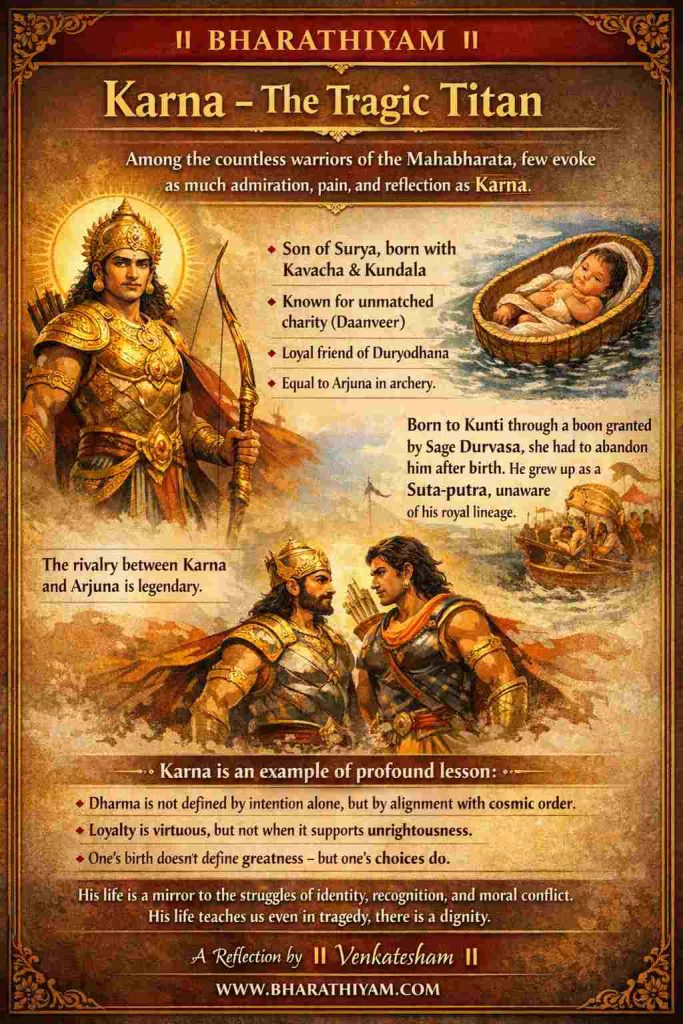
Among the countless warriors of the Mahabharata, few evoke as much admiration, pain, and reflection as Karna. Known for his unmatched generosity, unwavering loyalty, and extraordinary martial prowess, Karna stands as one of the most complex figures in Itihasa. He was not merely a warrior; he was a symbol of destiny’s harsh play and the consequences of choices bound by DharmaTransliteration: धर्म / Dharma Meaning / Explanation: That which upholds, sustains, and maintains cosmic and social order. Includes duty, righteousness, natural law, and inner truth. Origin: Sanskrit (from root dhṛ — “to hold, support”) Note: Dharma is contextual — it changes with role, time, and stage of life. More.
Often called the “Tragic Titan,” Karna’s life reflects a deep tension between merit and fate, greatness and rejection, righteousness and allegiance.
Birth and Divine Origins
Karna was born to Kunti before her marriage, through a boon granted by Sage Durvasa. By invoking Surya, she gave birth to a radiant child adorned with divine armor (Kavacha) and earrings (Kundala), symbols of invincibility.
However, bound by societal norms and fear of dishonor, Kunti abandoned the newborn. This single act shaped Karna’s entire life. Raised by a charioteer, Adhiratha, and his wife Radha, Karna grew up as a Suta-putra, unaware of his royal lineage.
The Struggle for Identity
Despite possessing the qualities of a Kshatriya, Karna was denied recognition due to his perceived low birth. His quest for respect led him to seek training under Dronacharya, who refused him.
Undeterred, Karna approached Parashurama, disguising himself as a Brahmin to gain knowledge. Though he became a master archer, his deception resulted in a curse from Parashurama—that he would forget crucial knowledge at the moment of greatest need.
This recurring theme of curses and denial shows how Karna’s life was not shaped by lack of ability, but by relentless obstacles imposed by destiny.
Friendship with Duryodhana
Karna’s life changed when Duryodhana recognized his worth and crowned him the king of Anga. This act gave Karna the respect he had always sought.
In return, Karna pledged lifelong loyalty to Duryodhana. This bond became both his strength and his downfall. While Duryodhana stood by Karna in a world that rejected him, Karna chose to stand by Duryodhana even when DharmaTransliteration: धर्म / Dharma Meaning / Explanation: That which upholds, sustains, and maintains cosmic and social order. Includes duty, righteousness, natural law, and inner truth. Origin: Sanskrit (from root dhṛ — “to hold, support”) Note: Dharma is contextual — it changes with role, time, and stage of life. More was clearly on the side of the Pandavas.
Here lies one of the deepest dilemmas in Dharma—does one prioritize personal gratitude or universal righteousness?
Karna vs Arjuna – Rivalry of Equals
The rivalry between Karna and Arjuna is legendary. Both were supreme archers, each representing different aspects of DharmaTransliteration: धर्म / Dharma Meaning / Explanation: That which upholds, sustains, and maintains cosmic and social order. Includes duty, righteousness, natural law, and inner truth. Origin: Sanskrit (from root dhṛ — “to hold, support”) Note: Dharma is contextual — it changes with role, time, and stage of life. More and destiny.
Arjuna had guidance, recognition, and divine support, especially from Krishna. Karna, on the other hand, walked a path of isolation, fueled by inner fire and resilience.
Yet, their final battle in the Kurukshetra War was not merely a contest of skill—it was the culmination of fate, curses, and moral choices.
The Generosity of Karna
Karna is often remembered as Daanveer Karna—the greatest giver. His generosity knew no bounds. The most striking example is when Indra, disguised as a Brahmin, asked for his divine armor and earrings.
Knowing fully that this would cost him his life, Karna still gave them away. This act of self-sacrifice reflects the highest ideal of Dana (charity) in Sanatana Dharma—giving without expectation, even at personal loss.
The Tragic End
Before the war, Kunti revealed the truth of Karna’s birth, asking him to join the Pandavas. Karna refused, choosing loyalty over lineage. However, he promised not to kill any of the Pandavas except Arjuna.
During his final battle, Karna faced multiple misfortunes—his chariot wheel sank, his curses manifested, and he momentarily lost his ability to fight. At that crucial moment, Arjuna, guided by Krishna, struck him down.
Karna’s death remains one of the most debated moments in the Mahabharata. Was it just? Or was it the inevitable conclusion of accumulated karmaTransliteration: Karma Meaning / Explanation: Action and its inevitable consequence. Not fate, but the law of cause and effect across lifetimes. Origin: Sanskrit (from kṛ — “to act”) Note: Karma includes intention, not just action. More?
Understanding Karna Through DharmaTransliteration: धर्म / Dharma Meaning / Explanation: That which upholds, sustains, and maintains cosmic and social order. Includes duty, righteousness, natural law, and inner truth. Origin: Sanskrit (from root dhṛ — “to hold, support”) Note: Dharma is contextual — it changes with role, time, and stage of life. More
Karna’s life cannot be judged in simple terms of right and wrong. He was noble, yet flawed. Loyal, yet aligned with adharma. Capable of greatness, yet bound by choices rooted in personal pain.
Sanatana DharmaTransliteration: धर्म / Dharma Meaning / Explanation: That which upholds, sustains, and maintains cosmic and social order. Includes duty, righteousness, natural law, and inner truth. Origin: Sanskrit (from root dhṛ — “to hold, support”) Note: Dharma is contextual — it changes with role, time, and stage of life. More does not present Karna as a villain, but as a profound lesson:
DharmaTransliteration: धर्म / Dharma Meaning / Explanation: That which upholds, sustains, and maintains cosmic and social order. Includes duty, righteousness, natural law, and inner truth. Origin: Sanskrit (from root dhṛ — “to hold, support”) Note: Dharma is contextual — it changes with role, time, and stage of life. More is not defined by intention alone, but by alignment with cosmic order.
Loyalty is virtuous, but not when it supports unrighteousness.
One’s birth does not define greatness—but one’s choices do.
Conclusion
Karna stands as a towering figure in the Mahabharata—not because he was perfect, but because he was deeply human. His life is a mirror to the struggles of identity, recognition, and moral conflict.
He teaches that greatness without alignment to DharmaTransliteration: धर्म / Dharma Meaning / Explanation: That which upholds, sustains, and maintains cosmic and social order. Includes duty, righteousness, natural law, and inner truth. Origin: Sanskrit (from root dhṛ — “to hold, support”) Note: Dharma is contextual — it changes with role, time, and stage of life. More leads to tragedy. Yet, even in tragedy, there is dignity.
In the grand narrative of the Mahabharata, Karna remains not just a warrior—but a timeless reflection of the human condition, where strength and sorrow walk together.
“When you are born with a question in your soul, the answer becomes your life’s work.”
Venkatesham is the founder and guiding spirit behind Bharathiyam — a digital dharmic initiative dedicated to reviving, preserving, and sharing the timeless soul-wisdom of Bharat.
Born into a traditional family rooted in simplicity, reverence, and moral strength, his life bridges two worlds — the outer world of technology and digital communication, and the inner world of silence, reflection, and spiritual seeking.
The articles and essays featured on Bharathiyam are not recent creations, but part of a lifelong body of work that began more than two decades ago. Many of them were originally written between 2000 and 2020, stored quietly as Word documents — reflections, insights, and learnings collected through years of sādhanā, study, and service. These writings are now being published in their original spirit, dated according to when they were first composed.
Alongside Bharathiyam, he continues to nurture two interconnected literary trilogies exploring dharma, family, and the soul’s journey — expressions of the same inner quest that began long ago and continues to unfold through his work and life.