My personal message is about the journey that shaped me, the lessons life taught me, and the realisations that pushed me back onto my own path. Every word you read here is mine — written from my own experiences, my own struggles, and the truths I discovered along the way.
Struggles and happiness are a part of life. If you don’t struggle, you won’t learn anything. If you don’t enjoy happiness, you won’t feel its essence. Both are just two sides of the same coin. Sometimes life feels like you’re swimming against the waves… but it’s only when you swim against the waves that you realise your own strength.
Dharma, Karma & Inner Evolution - In every age, societies celebrate “good people” — those who are kind, giving, honest, and willing to help without hesitation. Their intentions are noble, their hearts are soft, and their actions often uplift others. Yet, paradoxically, these very individuals frequently face exhaustion, heartbreak, and collapse.
Quiet reflections, visual messages, and life insights — shared without noise or debate.
For those who prefer to observe, reflect, and grow at their own pace.
Updates are occasional and intentional.
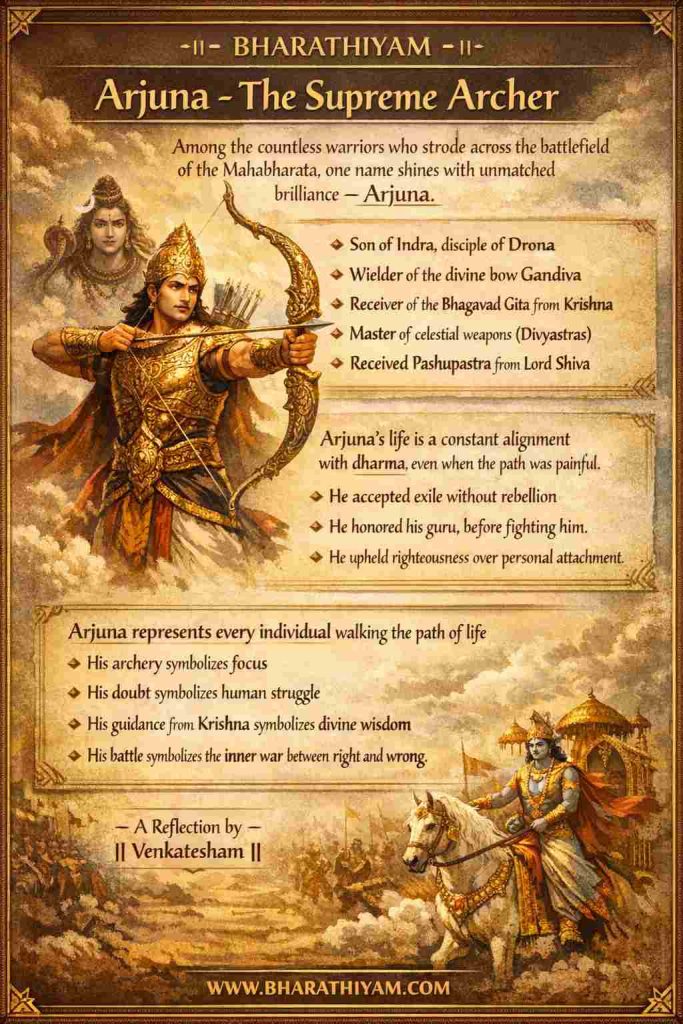
Among the countless warriors who strode across the battlefield of the Mahabharata, one name shines with unmatched brilliance — Arjuna. Known for his extraordinary archery, unwavering discipline, and deep spiritual evolution, Arjuna stands as the embodiment of the ideal Kshatriya — one who balances skill, duty, and dharmaTransliteration: धर्म / Dharma Meaning / Explanation: That which upholds, sustains, and maintains cosmic and social order. Includes duty, righteousness, natural law, and inner truth. Origin: Sanskrit (from root dhṛ — “to hold, support”) Note: Dharma is contextual — it changes with role, time, and stage of life. More.
He was not merely a warrior of physical prowess, but a seeker guided by wisdom, ultimately becoming the chosen recipient of the eternal teachings of the Bhagavad Gita through Krishna.
Arjuna’s title as the Supreme Archer was not given lightly — it was earned through relentless discipline and divine blessings.
Under the guidance of Dronacharya, Arjuna displayed unparalleled focus. The famous episode of hitting the eye of a rotating fish while looking only at its reflection is not merely a test of skill — it is a demonstration of absolute concentration (ekagrata).
While other students saw the tree, the bird, and the surroundings, Arjuna saw only the eye. This level of attention reflects a deeper inner discipline — the ability to eliminate distractions and align fully with the goal.
The Divine Warrior – Beyond Human Limits
Arjuna’s greatness was not confined to earthly training. His journey extended into the celestial realms.
He received powerful astras (divine weapons) from various deities:
From Shiva — the formidable Pashupatastra
From Indra — celestial weapons and combat mastery
From other divine beings — specialized astras for different situations
But what made Arjuna unique was not just possession of these weapons — it was his restraint. He understood when not to use them. In Sanatana DharmaTransliteration: धर्म / Dharma Meaning / Explanation: That which upholds, sustains, and maintains cosmic and social order. Includes duty, righteousness, natural law, and inner truth. Origin: Sanskrit (from root dhṛ — “to hold, support”) Note: Dharma is contextual — it changes with role, time, and stage of life. More, true power is always governed by dharmaTransliteration: धर्म / Dharma Meaning / Explanation: That which upholds, sustains, and maintains cosmic and social order. Includes duty, righteousness, natural law, and inner truth. Origin: Sanskrit (from root dhṛ — “to hold, support”) Note: Dharma is contextual — it changes with role, time, and stage of life. More, not ego.
Kurukshetra – The Battlefield of Dharma
At the onset of the Kurukshetra War, Arjuna faced his greatest challenge — not an external enemy, but an inner collapse.
Seeing his own teachers, relatives, and loved ones on the opposing side, he was overcome with grief and confusion. His bow, the Gandiva, slipped from his hands.
This moment is critical. The greatest warrior in history stood paralyzed — showing that even the strongest can face inner conflict.
It is here that Krishna delivered the teachings of the Bhagavad Gita — guiding Arjuna from emotional turmoil to clarity of dharmaTransliteration: धर्म / Dharma Meaning / Explanation: That which upholds, sustains, and maintains cosmic and social order. Includes duty, righteousness, natural law, and inner truth. Origin: Sanskrit (from root dhṛ — “to hold, support”) Note: Dharma is contextual — it changes with role, time, and stage of life. More.
Arjuna’s transformation from despair to decisive action is what truly defines him as “Supreme” — not just in skill, but in consciousness.
Arjuna and DharmaTransliteration: धर्म / Dharma Meaning / Explanation: That which upholds, sustains, and maintains cosmic and social order. Includes duty, righteousness, natural law, and inner truth. Origin: Sanskrit (from root dhṛ — “to hold, support”) Note: Dharma is contextual — it changes with role, time, and stage of life. More
Arjuna’s life is a constant alignment with dharmaTransliteration: धर्म / Dharma Meaning / Explanation: That which upholds, sustains, and maintains cosmic and social order. Includes duty, righteousness, natural law, and inner truth. Origin: Sanskrit (from root dhṛ — “to hold, support”) Note: Dharma is contextual — it changes with role, time, and stage of life. More, even when the path was painful.
He accepted exile without rebellion
He honored his गुरु, even when it meant fighting against them
He upheld righteousness over personal attachment
Unlike many warriors driven by pride or vengeance, Arjuna’s actions were guided by higher principles.
Even in victory, there was no arrogance. His strength remained anchored in humility and surrender to the divine will.
The Symbolism of Arjuna
Arjuna is not just a historical or epic figure — he represents every individual walking the path of life.
His archery symbolizes focus
His doubt symbolizes human struggle
His guidance from Krishna symbolizes divine wisdom
His battle symbolizes the inner war between right and wrong
In this sense, the Mahabharata is not just a story of the past — it is a mirror of human life.
Conclusion
Arjuna stands as one of the greatest warriors not merely because of his unmatched skill with the bow, but because of his inner journey.
His life teaches that true greatness is not in external victories alone, but in mastering oneself. Skill without dharmaTransliteration: धर्म / Dharma Meaning / Explanation: That which upholds, sustains, and maintains cosmic and social order. Includes duty, righteousness, natural law, and inner truth. Origin: Sanskrit (from root dhṛ — “to hold, support”) Note: Dharma is contextual — it changes with role, time, and stage of life. More leads to destruction, but skill guided by dharmaTransliteration: धर्म / Dharma Meaning / Explanation: That which upholds, sustains, and maintains cosmic and social order. Includes duty, righteousness, natural law, and inner truth. Origin: Sanskrit (from root dhṛ — “to hold, support”) Note: Dharma is contextual — it changes with role, time, and stage of life. More becomes a force of cosmic balance.
In the vast canvas of the Mahabharata, Arjuna emerges not just as a warrior — but as a seeker, a student, and ultimately, a realized instrument of dharmaTransliteration: धर्म / Dharma Meaning / Explanation: That which upholds, sustains, and maintains cosmic and social order. Includes duty, righteousness, natural law, and inner truth. Origin: Sanskrit (from root dhṛ — “to hold, support”) Note: Dharma is contextual — it changes with role, time, and stage of life. More.
“When you are born with a question in your soul, the answer becomes your life’s work.”
Venkatesham is the founder and guiding spirit behind Bharathiyam — a digital dharmic initiative dedicated to reviving, preserving, and sharing the timeless soul-wisdom of Bharat.
Born into a traditional family rooted in simplicity, reverence, and moral strength, his life bridges two worlds — the outer world of technology and digital communication, and the inner world of silence, reflection, and spiritual seeking.
The articles and essays featured on Bharathiyam are not recent creations, but part of a lifelong body of work that began more than two decades ago. Many of them were originally written between 2000 and 2020, stored quietly as Word documents — reflections, insights, and learnings collected through years of sādhanā, study, and service. These writings are now being published in their original spirit, dated according to when they were first composed.
Alongside Bharathiyam, he continues to nurture two interconnected literary trilogies exploring dharma, family, and the soul’s journey — expressions of the same inner quest that began long ago and continues to unfold through his work and life.