A visit between Dawn to Dusk! A visit to all three Ranganatha Swamy Temples on the same day between sunrise and sunset! Aren’t you excited right now to go on Triranga Darshan in one day! It is believed a visit to three Sriranganatha Swamy temples between dawn to dusk called “Triranga Darshan”
Bharathiyam was first conceived on March 14, 2000, as a seed idea — long before India’s cultural heritage found a home online. Though the domain was registered on that very day, its deeper blossoming required 25 years of experience, inner churning, and karmic purification.
Every civilization is born, grows, declines, and often disappears into the pages of history. Yet Bharat, the land sanctified by rishis, rivers, and the rhythm of Sanātana Dharma, stands apart. It is not merely a civilization of the past but a living continuum that has nourished countless generations, adapting to time yet never losing its eternal pulse.
Spiritual Movement Spiritual Movements – The Living Rivers of Awakening From the hymns of the Vedas to the songs of the saints, Bharat’s spiritual history flows through countless movements of love, wisdom, and inner transformation. Each age gave birth to seekers who re-discovered the timeless truth — that divinity lives within every heart.
My personal message is about the journey that shaped me, the lessons life taught me, and the realisations that pushed me back onto my own path. Every word you read here is mine — written from my own experiences, my own struggles, and the truths I discovered along the way.
Struggles and happiness are a part of life. If you don’t struggle, you won’t learn anything. If you don’t enjoy happiness, you won’t feel its essence. Both are just two sides of the same coin. Sometimes life feels like you’re swimming against the waves… but it’s only when you swim against the waves that you realise your own strength.
Dharma, Karma & Inner Evolution - In every age, societies celebrate “good people” — those who are kind, giving, honest, and willing to help without hesitation. Their intentions are noble, their hearts are soft, and their actions often uplift others. Yet, paradoxically, these very individuals frequently face exhaustion, heartbreak, and collapse.
Quiet reflections, visual messages, and life insights — shared without noise or debate.
For those who prefer to observe, reflect, and grow at their own pace.
Updates are occasional and intentional.
In the spiritual vision of Sanatana DharmaTransliteration: धर्म / Dharma Meaning / Explanation: That which upholds, sustains, and maintains cosmic and social order. Includes duty, righteousness, natural law, and inner truth. Origin: Sanskrit (from root dhṛ — “to hold, support”) Note: Dharma is contextual — it changes with role, time, and stage of life. More, food is not merely a material necessity. It is sacred. It is life itself. The ancient scriptures teach that food is divine nourishment given to sustain all beings, and the goddess who presides over this sacred nourishment is Sri Annapurna Devi.
The name Annapurna itself carries deep meaning. It is formed from two Sanskrit words: “Anna” meaning food or grain, and “Purna” meaning fullness or completeness. Thus, Annapurna Devi is the Mother who eternally fills the world with nourishment and abundance.
She represents the eternal truth that the Divine Mother feeds the entire universe.
The Divine Form of Annapurna
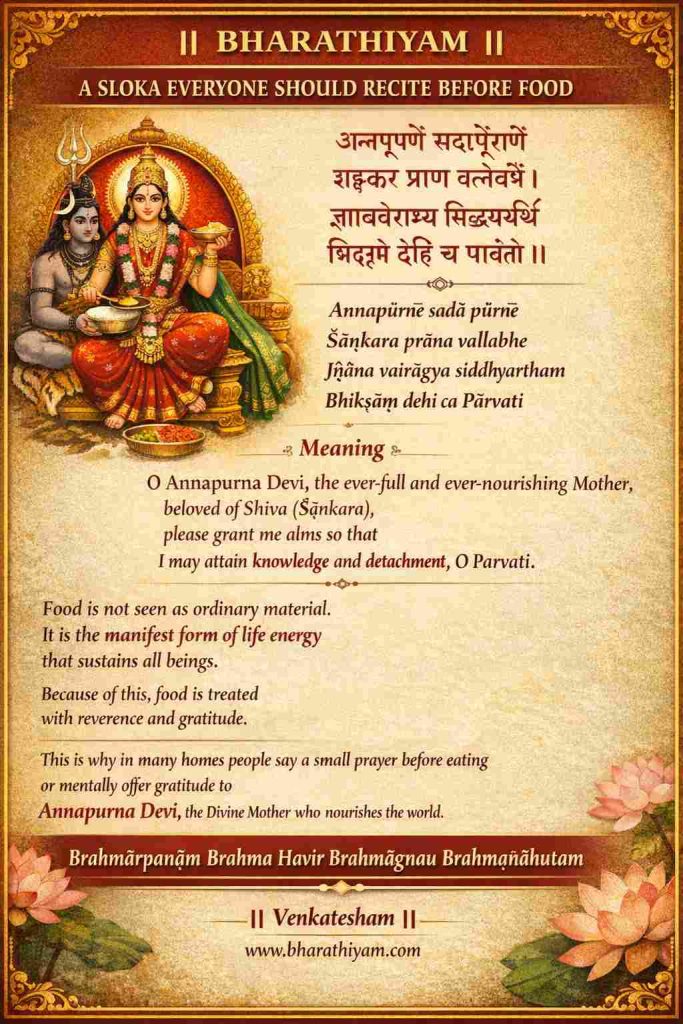
Sri Annapurna Devi is traditionally depicted as a compassionate mother holding a vessel filled with food in one hand and a ladle in the other, symbolizing the act of feeding the world. Her form expresses generosity, care, and nurturing energy.
In many sacred images, Lord Shiva stands before her with a begging bowl, while she offers food to him. This imagery carries profound symbolism. Even Shiva, the great ascetic and cosmic consciousness, receives nourishment from the Divine Mother.
This reminds us that the material and spiritual worlds are sustained by the same divine source.
The Sacred Story of Annapurna
A well-known traditional story explains the origin of Annapurna Devi.
Once, Lord Shiva declared that the material world was merely an illusion (Maya) and that food itself had no ultimate reality. Hearing this, Goddess Parvati decided to teach the world an important lesson.
She disappeared from the world, and with her disappearance all food vanished from the earth. Crops stopped growing, hunger spread everywhere, and even the gods suffered from the absence of nourishment.
Only then did the truth become clear: without food, life cannot exist.
Realizing the importance of nourishment, Lord Shiva approached the Goddess and requested food. Parvati then appeared in the sacred city of Kashi in the form of Sri Annapurna Devi, distributing food to all beings.
Through this act, she demonstrated that food is sacred and must never be disrespected or wasted.
Food as Sacred in Sanatana Dharma
The reverence for food in Hindu tradition comes from ancient scriptural teachings. The Taittiriya Upanishad declares:
“Annam Brahma.” Food is BrahmanTransliteration: ब्रह्मन् / Brahman Meaning / Explanation: Absolute reality; infinite, formless, unchanging consciousness from which all existence arises. Origin: Sanskrit Note: “Ātman = Brahman” is the core Upanishadic realization. More.
This profound statement teaches that food itself is a manifestation of the divine presence.
Because of this understanding, traditional households follow several practices that reflect gratitude toward food:
No grain of food should be wasted.
Food should never be insulted or disrespected.
Meals should begin with prayer or gratitude.
Food should be shared with guests, animals, and the needy.
These practices are not merely cultural habits; they are expressions of Anna-Dharma — the sacred duty to respect nourishment.
The Annapurna Mantra
One of the most well-known prayers offered to the goddess is the Annapurna Stotram, which beautifully captures the spiritual meaning of nourishment.
अन्नपूर्णे सदापूर्णे शङ्करप्राणवल्लभे । ज्ञानवैराग्यसिद्ध्यर्थं भिक्षां देहि च पार्वति ॥
Annapūrṇe sadā pūrṇe Śaṅkara prāṇa vallabhe JñānaTransliteration: Jñāna / ज्ञान Meaning / Explanation: Experiential wisdom; knowledge born of realization. Origin: Sanskrit Note: Jñāna dissolves ignorance directly. MorevairāgyaTransliteration: Vairāgya / वैराग्य Meaning / Explanation: Detachment arising from understanding, not rejection. Origin: Sanskrit Note: Vairāgya is maturity, not renunciation alone. More siddhyartham Bhikṣāṁ dehi ca Pārvatī.
The prayer means:
“O Annapurna, the ever-full Mother and beloved of Shiva, grant us your divine alms so that we may attain knowledge and detachment.”
Interestingly, the devotee does not ask merely for food or wealth. Instead, the prayer asks for Jnana (wisdom) and Vairagya (detachment) — the higher nourishment of the soul.
Annapurna and Prosperity
In Hindu thought, prosperity is not measured only by wealth. True abundance includes food, health, peace, and spiritual growth.
This is why Annapurna Devi is closely connected with Sri Lakshmi, the goddess of wealth. Wealth without food has no meaning, and food without gratitude loses its sacred value.
Thus, Annapurna represents the foundation of all prosperity.
Traditional wisdom therefore teaches that a household where food is respected, shared, and never wasted becomes a place where abundance naturally resides.
The Eternal Mother of Nourishment
The Sacred Meaning of Food: Understanding Goddess Annapurna
Behind every grain of rice lies the work of nature, the effort of farmers, the nourishment of the earth, and the grace of the Divine Mother.
When food is received with gratitude, it becomes more than nourishment for the body — it becomes a reminder of the sacred relationship between humanity and the universe.
In honoring Annapurna Devi, we honor the principle that life itself is sustained by divine compassion.
And so, before every meal, many devotees remember the Mother who feeds the world and silently offer gratitude to Sri Annapurna Devi — the eternal source of nourishment, abundance, and grace.
“When you are born with a question in your soul, the answer becomes your life’s work.”
Venkatesham is the founder and guiding spirit behind Bharathiyam — a digital dharmic initiative dedicated to reviving, preserving, and sharing the timeless soul-wisdom of Bharat.
Born into a traditional family rooted in simplicity, reverence, and moral strength, his life bridges two worlds — the outer world of technology and digital communication, and the inner world of silence, reflection, and spiritual seeking.
The articles and essays featured on Bharathiyam are not recent creations, but part of a lifelong body of work that began more than two decades ago. Many of them were originally written between 2000 and 2020, stored quietly as Word documents — reflections, insights, and learnings collected through years of sādhanā, study, and service. These writings are now being published in their original spirit, dated according to when they were first composed.
Alongside Bharathiyam, he continues to nurture two interconnected literary trilogies exploring dharma, family, and the soul’s journey — expressions of the same inner quest that began long ago and continues to unfold through his work and life.