A visit between Dawn to Dusk! A visit to all three Ranganatha Swamy Temples on the same day between sunrise and sunset! Aren’t you excited right now to go on Triranga Darshan in one day! It is believed a visit to three Sriranganatha Swamy temples between dawn to dusk called “Triranga Darshan”
Bharathiyam was first conceived on March 14, 2000, as a seed idea — long before India’s cultural heritage found a home online. Though the domain was registered on that very day, its deeper blossoming required 25 years of experience, inner churning, and karmic purification.
Every civilization is born, grows, declines, and often disappears into the pages of history. Yet Bharat, the land sanctified by rishis, rivers, and the rhythm of Sanātana Dharma, stands apart. It is not merely a civilization of the past but a living continuum that has nourished countless generations, adapting to time yet never losing its eternal pulse.
Spiritual Movement Spiritual Movements – The Living Rivers of Awakening From the hymns of the Vedas to the songs of the saints, Bharat’s spiritual history flows through countless movements of love, wisdom, and inner transformation. Each age gave birth to seekers who re-discovered the timeless truth — that divinity lives within every heart.
My personal message is about the journey that shaped me, the lessons life taught me, and the realisations that pushed me back onto my own path. Every word you read here is mine — written from my own experiences, my own struggles, and the truths I discovered along the way.
Struggles and happiness are a part of life. If you don’t struggle, you won’t learn anything. If you don’t enjoy happiness, you won’t feel its essence. Both are just two sides of the same coin. Sometimes life feels like you’re swimming against the waves… but it’s only when you swim against the waves that you realise your own strength.
Dharma, Karma & Inner Evolution - In every age, societies celebrate “good people” — those who are kind, giving, honest, and willing to help without hesitation. Their intentions are noble, their hearts are soft, and their actions often uplift others. Yet, paradoxically, these very individuals frequently face exhaustion, heartbreak, and collapse.
Quiet reflections, visual messages, and life insights — shared without noise or debate.
For those who prefer to observe, reflect, and grow at their own pace.
Updates are occasional and intentional.
Among the countless mantras that echo through the spiritual traditions of Sanātana DharmaTransliteration: सनातन धर्म / Sanātana Dharma Meaning / Explanation: Sanātana Dharma means the eternal way of righteous living. It is the timeless cosmic law that governs the universe, life, and consciousness. It is not a religion founded by a person, bound to a single book, or limited by geography or More, the Gayatri Mantra holds a unique and timeless place. It is revered as the Mother of the Vedas (Veda Mātā) and is considered the very essence of divine knowledge. The seers of ancient India declared that the Gayatri Mantra, when understood and recited with purity, can illuminate the mind, awaken the soul, and guide one toward righteous living.
Transliteration: Om bhūr bhuvaḥ svaḥ tat savitur vareṇyaṃ bhargo devasya dhīmahi dhiyo yo naḥ pracodayāt
Meaning
Om – The primordial sound, the vibration of creation.
Bhūr, Bhuvaḥ, Svaḥ – The three worlds: earth, atmosphere, and heavens; also body, mind, and soul.
Tat – That (the Supreme Reality).
Savitur – Of Savitṛ, the Divine Sun, source of life and light.
Vareṇyam – Worthy of worship and adoration.
Bhargo – The effulgent radiance, the purifier.
Devasya – Of the Divine.
Dhīmahi – We meditate upon.
Dhiyo Yo Naḥ Prachodayāt – May that Divine Light inspire and awaken our intellects.
In essence: “We meditate upon the radiant light of the Divine Sun; may it awaken and guide our intelligence toward the path of truth.”
Scriptural References
Rigveda (3.62.10): Original source of the mantra.
Yajurveda & Samaveda: Reiterate the sacred importance of Gayatri.
Bhagavad Gītā (10.35): Krishna declares, “Among mantras, I am the Gayatri.”
Manu Smriti (2.77): States that one who recites the Gayatri with devotion purifies himself just as a lotus is cleansed by water.
Spiritual Significance
Illumination of Intellect: Gayatri is the mantra of light (jyoti). It removes ignorance (avidyāTransliteration: Avidyā Meaning / Explanation: Ignorance of one’s true nature; root cause of bondage. Origin: Sanskrit Note: Not lack of information, but lack of realization. More) and sharpens inner clarity.
Universal Prayer: Unlike mantras restricted to certain deities, Gayatri addresses the Supreme as Savitṛ—the cosmic source of life—making it accessible to all.
Balance of Body, Mind & Spirit: The mantra harmonizes the three levels of existence symbolized by bhūr, bhuvaḥ, svaḥ.
Awakening of DharmaTransliteration: धर्म / Dharma Meaning / Explanation: That which upholds, sustains, and maintains cosmic and social order. Includes duty, righteousness, natural law, and inner truth. Origin: Sanskrit (from root dhṛ — “to hold, support”) Note: Dharma is contextual — it changes with role, time, and stage of life. More: It aligns the chanter with righteousness, ensuring thoughts, words, and actions move toward truth.
Practice & Chanting
When to Chant: Traditionally, at sandhyā kāla—dawn, noon, and dusk—when the transitions of nature are most powerful.
How to Chant: Sit in a calm place, spine erect, and recite 108 times using a mala or mentally. Focus on the rising sun or inner light.
Mental Attitude: Faith, purity, and humility are essential; the mantra is not mere sound but a bridge to the Divine.
Benefits
Mental Clarity: Strengthens concentration and memory, ideal for students and seekers.
Spiritual Protection: The divine radiance is said to shield the devotee from negativity.
Emotional Balance: Instills calmness and reduces anxiety.
Universal Harmony: As a prayer for enlightenment, it uplifts not only the individual but collective consciousness.
Symbolism of Gayatri as a Goddess
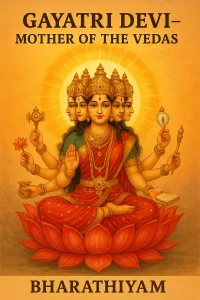
Gayatri is personified as a divine Mother, seated on a red lotus, with five faces (representing the five elements and five prāṇas) and ten arms holding the weapons of knowledge. She represents the boundless wisdom of the Vedas and the compassionate guide who leads seekers to truth.
Relevance in Modern Times
In an era of distraction, stress, and confusion, the Gayatri Mantra remains a timeless tool for inner alignment. It transcends religion, caste, and creed, addressing the universal need for light and wisdom. Reciting it daily can become a personal discipline of clarity, courage, and compassion.
Closing Thought
The Gayatri Mantra is more than words—it is a vibration that links the individual soul (jīvātman) with the cosmic soul (paramātman). To chant it is to invite illumination, to live by it is to walk in the radiance of truth.
“As the sun dispels darkness, so too does Gayatri dispel ignorance—revealing the path of dharmaTransliteration: धर्म / Dharma Meaning / Explanation: That which upholds, sustains, and maintains cosmic and social order. Includes duty, righteousness, natural law, and inner truth. Origin: Sanskrit (from root dhṛ — “to hold, support”) Note: Dharma is contextual — it changes with role, time, and stage of life. More, knowledge, and moksha.”
“When you are born with a question in your soul, the answer becomes your life’s work.”
Venkatesham is the founder and guiding spirit behind Bharathiyam — a digital dharmic initiative dedicated to reviving, preserving, and sharing the timeless soul-wisdom of Bharat.
Born into a traditional family rooted in simplicity, reverence, and moral strength, his life bridges two worlds — the outer world of technology and digital communication, and the inner world of silence, reflection, and spiritual seeking.
The articles and essays featured on Bharathiyam are not recent creations, but part of a lifelong body of work that began more than two decades ago. Many of them were originally written between 2000 and 2020, stored quietly as Word documents — reflections, insights, and learnings collected through years of sādhanā, study, and service. These writings are now being published in their original spirit, dated according to when they were first composed.
Alongside Bharathiyam, he continues to nurture two interconnected literary trilogies exploring dharma, family, and the soul’s journey — expressions of the same inner quest that began long ago and continues to unfold through his work and life.