My personal message is about the journey that shaped me, the lessons life taught me, and the realisations that pushed me back onto my own path. Every word you read here is mine — written from my own experiences, my own struggles, and the truths I discovered along the way.
Struggles and happiness are a part of life. If you don’t struggle, you won’t learn anything. If you don’t enjoy happiness, you won’t feel its essence. Both are just two sides of the same coin. Sometimes life feels like you’re swimming against the waves… but it’s only when you swim against the waves that you realise your own strength.
Dharma, Karma & Inner Evolution - In every age, societies celebrate “good people” — those who are kind, giving, honest, and willing to help without hesitation. Their intentions are noble, their hearts are soft, and their actions often uplift others. Yet, paradoxically, these very individuals frequently face exhaustion, heartbreak, and collapse.
Quiet reflections, visual messages, and life insights — shared without noise or debate.
For those who prefer to observe, reflect, and grow at their own pace.
Updates are occasional and intentional.
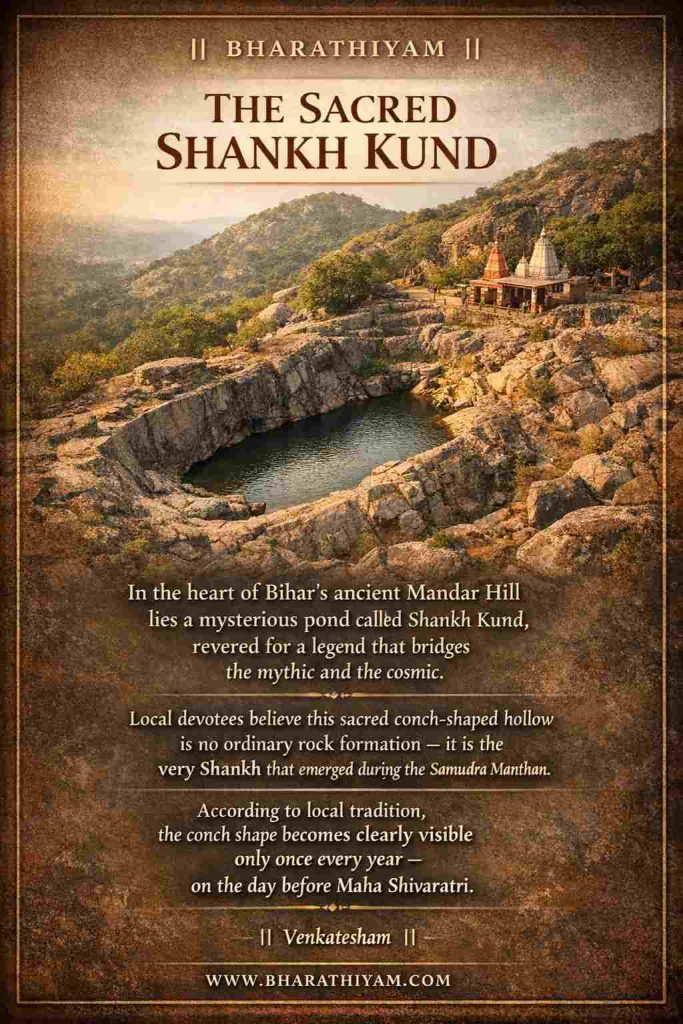
High in the heart of Bihar’s ancient Mandar Hill lies a mysterious pond called Shankh Kund, revered for a legend that bridges the mythic and the cosmic. Local devotees believe that this sacred conch-shaped hollow is no ordinary rock formation — it is the very Shankh (conch) that appeared during the Samudra Manthan, the great churning of the cosmic ocean. It is said that within this conch, Lord Shiva contained the deadly Halahala poison, protecting the entire creation from destruction.
Every year, a day before Maha Shivaratri, pilgrims claim that the conch miraculously reveals itself — shimmering faintly beneath the waters, as if Shiva’s own memory awakens once more to remind the world of His sacrifice.
Mandar Parvat — The Mountain That Stirred the Ocean
Mandar Parvat, also known as Mandar Hill, rises quietly near Banka district in southern Bihar. Though modest in height, this hill carries the weight of millennia of mythology. According to the Bhagavata Purāṇa, Vishnu chose Mandara Parvata as the mountain to serve as the churning rod (Manthana Danda) during the great Samudra Manthan — the celestial event where gods (Devas) and demons (Asuras) churned the ocean of milk to obtain Amṛta, the nectar of immortality.
To keep the mountain from sinking, Lord Vishnu incarnated as the Kurma Avatar, the divine tortoise, supporting the entire weight upon His back. As the churning went on, treasures and celestial beings arose — the moon, the goddess Lakṣmī, the divine horse Ucchaihśravā, and the wish-granting tree Kalpavṛkṣa. But before the nectar of immortality emerged, a deadly blue poison called Hālāhala surfaced, threatening to consume all existence.
The Compassion of Neelakantha
In that moment of cosmic peril, Lord Shiva, moved by compassion for all beings, gathered the poison into His hands and drank it. To prevent the poison from spreading through His body, Goddess Pārvatī gently held His throat, trapping the venom there. From that day, He became Nīlakaṇṭha, the Blue-Throated One — the protector who swallowed death itself for the sake of life.
Some local traditions in Bihar’s Mandar Parvat go a step further. They say the sacred conch-shaped depression in the rock — the Shankh Kund — was formed by the very conch in which Shiva held the poison. Within that conch, the deadly Hālāhala was cooled and contained before He drank it, transforming destruction into divine power. Hence, this place is revered not merely as a symbol of the churning but as the spot where compassion conquered death.
The Mystery of Shankh Kund
The Shankh Kund is a naturally shaped rock depression, partially filled with water. During much of the year, its form remains submerged, but according to locals, the conch shape becomes clearly visible only once annually, a day before Maha Shivaratri. Devotees gather from surrounding villages and districts to witness this rare event, offering milk, flowers, and prayers to Lord Shiva.
Some describe a gentle vibration or glow near the waters, as though the sacred energy of the Neelakantha Tattva — the principle of transmuting poison into purity — still resides within the rock. For others, it is a moment of deep meditation, a reminder that every poison in life can be transformed through awareness, devotion, and surrender.
While scientific explanations point to seasonal water levels and natural rock formations, the spiritual symbolism remains profound. In the eyes of devotees, Mandar Parvat is not just a hill — it is the axis of cosmic memory, where divine compassion once neutralized the universe’s darkest force.
A Meeting Point of Faith and History
Mandar Parvat holds significance in multiple traditions. For Hindus, it is the mountain of churning, sanctified by Vishnu and Shiva. For Jains, it marks the place where Tirthankara Vasupujya attained enlightenment. Temples, inscriptions, and ancient carvings across the hill testify to centuries of uninterrupted reverence.
The hill’s geography itself reinforces its mythic imagery. Two main water bodies — Paapharani Kund (“the sin-destroying tank”) and Shankh Kund — rest on its slopes. The former is used for ritual purification, while the latter symbolizes the mystical containment of the poison. Local folklore says that anyone who sincerely worships at Shankh Kund and performs abhishekam with devotion receives Shiva’s blessing to overcome inner toxins — anger, greed, jealousy, and fear.
Spiritual Significance — The Inner Churning
The legend of Shankh Kund carries more than historical or mythological meaning. It mirrors the inner process of Samudra Manthan that every seeker must undergo. Our mind is the ocean; our thoughts are the waves; and within that ocean lie hidden both poison and nectar. Through meditation, reflection, and dharmic living, one churns this ocean within. When negative emotions rise — the inner Hālāhala — they must be offered to Lord Shiva, the symbol of pure awareness, so that they may be transmuted into wisdom.
Thus, the Shankh Kund at Mandar Parvat is not only a place of pilgrimage but a living metaphor for spiritual alchemy — a reminder that the divine resides in the act of transformation itself.
Visiting Mandar Parvat
Located around 45 km from Bhagalpur, Mandar Parvat is accessible by road and rail. The region remains peaceful and imbued with rural simplicity. The Mandar Mahotsav festival, held annually, celebrates its mythological and cultural heritage. Pilgrims often combine their journey with nearby sacred sites like Sultanganj and Deoghar (Baijnath Dham).
Those who visit during Maha Shivaratri often witness the emergence of the Shankh Kund, a mystical sight that draws crowds in silence and awe. Whether viewed as divine miracle or geological wonder, the experience leaves one humbled — a tangible connection between myth and matter.
Conclusion — Where Faith Meets Eternity
The story of Shankh Kund is more than legend; it is a timeless reflection of dharmic truth — that the highest strength lies not in conquest but in compassion. Lord Shiva’s act at Mandar Parvat symbolizes the eternal dharmaTransliteration: धर्म / Dharma Meaning / Explanation: That which upholds, sustains, and maintains cosmic and social order. Includes duty, righteousness, natural law, and inner truth. Origin: Sanskrit (from root dhṛ — “to hold, support”) Note: Dharma is contextual — it changes with role, time, and stage of life. More: the courage to hold, transform, and release what the world cannot bear.
Every devotee who bows before the waters of Shankh Kund silently repeats that act — acknowledging that we, too, must learn to transmute our poisons into light.
“When you are born with a question in your soul, the answer becomes your life’s work.”
Venkatesham is the founder and guiding spirit behind Bharathiyam — a digital dharmic initiative dedicated to reviving, preserving, and sharing the timeless soul-wisdom of Bharat.
Born into a traditional family rooted in simplicity, reverence, and moral strength, his life bridges two worlds — the outer world of technology and digital communication, and the inner world of silence, reflection, and spiritual seeking.
The articles and essays featured on Bharathiyam are not recent creations, but part of a lifelong body of work that began more than two decades ago. Many of them were originally written between 2000 and 2020, stored quietly as Word documents — reflections, insights, and learnings collected through years of sādhanā, study, and service. These writings are now being published in their original spirit, dated according to when they were first composed.
Alongside Bharathiyam, he continues to nurture two interconnected literary trilogies exploring dharma, family, and the soul’s journey — expressions of the same inner quest that began long ago and continues to unfold through his work and life.